
We work with many sales teams, and the same conversation keeps coming up. Sellers are doing the things they have always done, the things that used to work, and the deals are still slipping. Cycles are getting longer. Win rates are dropping. Stakeholders the team has never met are showing up late and killing the deal.
When we look at what is actually happening, it is not really a sales execution problem. It is a buyer problem. The buyer has changed faster than most sales teams have, and the gap is starting to show up in the numbers.
This article is about the buyer. What they are doing before they speak to you, how big their buying group has become, and what they actually want from a seller now.
The buyer arrives at the first sales conversation having already done most of the discovery work the seller used to be paid to do.
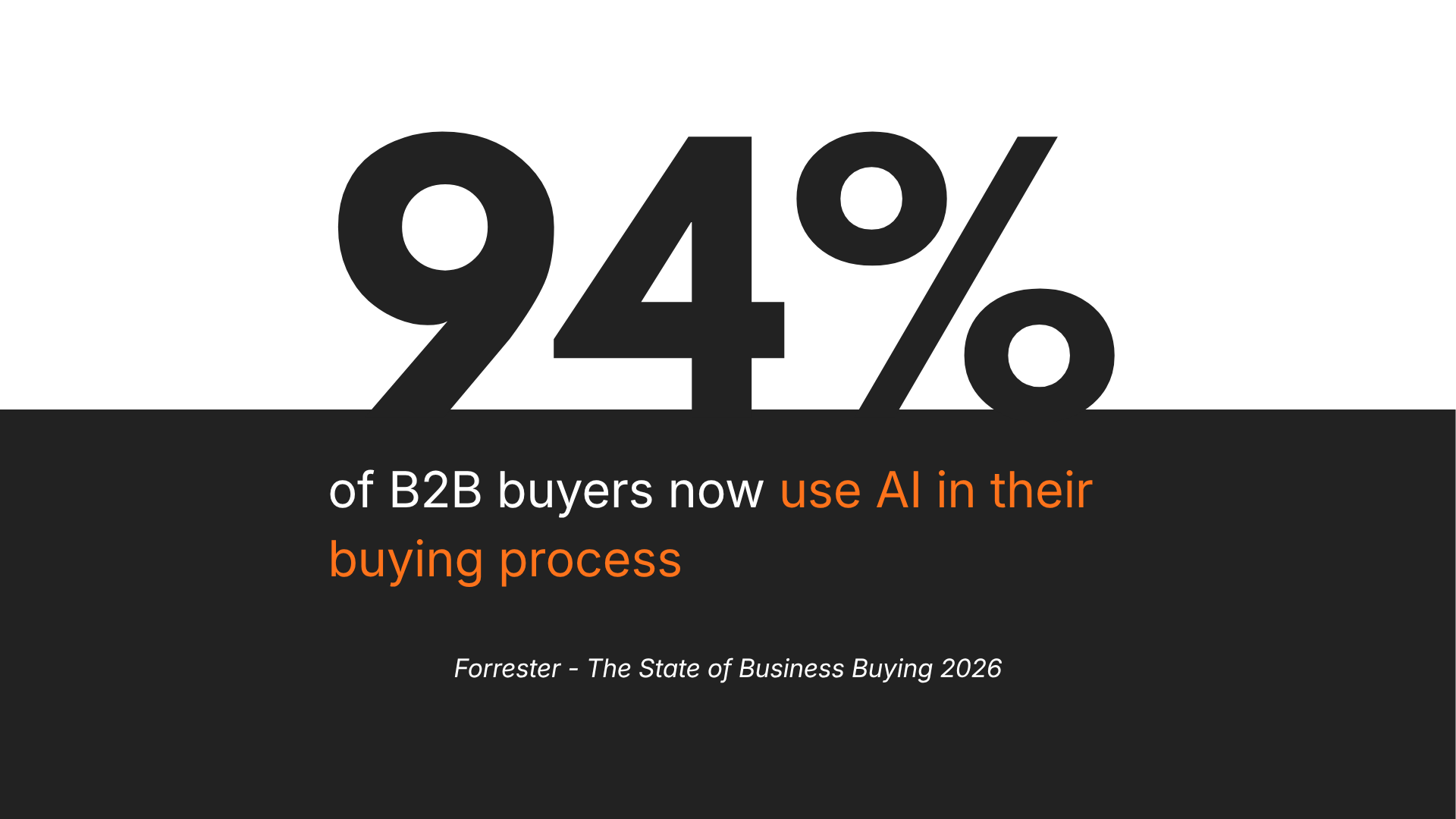
Forrester’s State of Business Buying 2026, drawing on its 2025 Buyers’ Journey Survey, found that generative AI tools were the single most cited meaningful interaction type for researching purchases. That is up from 89% in the 2024 survey, the year before. By the 2025 survey, generative AI had become a more meaningful source of information for buyers than any other source they had access to, including the seller they eventually spoke to.
By the time a buyer picks up the phone, they have typically:
A seller walking into that first call without knowing all of that is walking in blind. The buyer is several steps ahead, and they know it.
By the time the seller picks up the phone, the buyer has often spent more hours on the deal than the seller has.
This is the number that should be reshaping how sales teams are trained.
Forrester’s State of Business Buying 2026 shows the typical B2B buying decision now involves 13 internal stakeholders and nine external influencers. That is 22 people whose views shape the outcome of a single deal. For purchases involving generative AI features, the buying group typically doubles in size.
Most of the sales playbooks still being used were built to identify the economic buyer and influence them. That logic does not survive contact with a 22-person buying group. The economic buyer is still in the room, but they are one voice in a chorus. Procurement, security, finance, legal, the end users, the executive sponsor, and the external advisors. Each one can block. Most have specific concerns. None of them will be in every meeting with you.
The seller’s job has shifted. It is no longer about influencing the decision-maker. It is about helping a buying group of 22 people reach a confident, defensible answer together, often without the seller in the room when the real conversations happen.
That is a different skill set, and we are not seeing it being trained for in most teams.
Because the cost of a bad decision has gone up, and buyers know it.
Forrester’s 2026 research shows buyers are now using trials to reduce purchase risk in much higher numbers, with a growing reliance on trial environments before they will commit. The headline number is striking: only 36% of buyers say they plan to convert to the paid version of the trial they ran, while 35% say they plan to convert to a different provider entirely. Buyers are no longer committing on the strength of a pitch deck and three reference calls. They want to see the thing work in their environment, with their data, before they sign, and they are increasingly willing to walk away after a trial if it does not convince them.
Three things are driving this.
Risk aversion is higher. Most B2B buyers have been burned by a previous purchase. Software that did not integrate, a service that overpromised, a vendor relationship that fell apart once the contract was signed. They have learned to verify before they trust, and they are right to.
Internal accountability is sharper. Those 22 stakeholders are not just consulting on the decision. They are signing off on it. Every one of them is exposed if the decision goes wrong, so they want evidence they can defend internally.
AI has raised the bar on evidence. When a buyer can ask ChatGPT to surface three independent reviews of your product in 30 seconds, your testimonials page is not enough anymore. Buyers expect harder evidence, and they expect to verify it themselves.
The seller who turns up with a polished deck and a pricing sheet is increasingly out of step.
The seller who shows up with a structured way to help the buyer prove the value to themselves is more likely to win the deal.
Three things, and none of them are what most sellers have been trained to deliver.
A collaborator, not a presenter. The buyer does not need to be told about the product. They have already read about it. What they need is help defining what success looks like in their specific context, with their specific constraints and their specific success criteria.
A guide through the buying group, not a route to the decision-maker. The seller’s role is increasingly to help the internal champion navigate consensus across all 22 stakeholders. That means giving the champion the right materials for each audience, anticipating objections from procurement and security before they land, and keeping the relationship alive across the long stretches when no seller is in the room.
A path to proof, not a path to signature. Buyers expect a structured way to validate the value before they commit. The seller who treats the trial or the pilot as a formality at the end of the cycle is missing the point. For the modern buyer, the proof phase is where the real decision is made.
If your sellers are pitching to informed buyers, hunting for the single decision-maker in a group of 22, and treating proof as an afterthought, you will see conversion rates fall and cycle times lengthen. That is not a talent issue. The approach itself no longer fits the buyer.
The teams that adjust early compound the advantage. Modern buyers talk to each other. The vendor that runs a clean, collaborative, proof-led process gets recommended into the next deal. The vendor that does not gets quietly removed from the shortlist before the first call ever happens.
The buyer is not coming back. The information asymmetry that gave sellers their historical advantage is gone and not returning. AI has accelerated this shift, but the direction has been clear for at least a decade.
The question for sales leaders is whether the way your team sells has been redesigned to reflect how buyers now buy. In our experience, most have not, and that is where the deals are being lost.
If you want to understand why the legacy methodologies are struggling with this new buyer, we have written about that here. And if you want to see the methodology we have built in response, you can read about CORD here.
If you would like to talk through how your sales team is holding up against the modern buyer, get in touch with the Sales Engine team. We would be happy to walk through it with you.
Ian Elam is CRO of Sales Engine.
New to Sales Engine? Begin with the Commercial Performance Diagnostic.