
Most sales methodologies in use today were designed for a different world. A world where the seller controlled the information, guided the conversation and held the insight advantage.
That world is gone, and I think most commercial leaders know it.
Buyers arrive informed. Buying groups are larger and more sceptical. Proof is expected before commitment, not after. The frameworks I grew up with, including MEDDIC, SPIN and Challenger, were built for an environment where the seller held the cards. They still contain useful principles. But as complete systems for complex sales in 2026, they are showing their age.
This article introduces CORD: the methodology we’ve built at Sales Engine in response. It is designed for the way modern commercial relationships actually work, across marketing, sales and customer success.
The short answer: they were designed for a world where the seller controlled the information, and that assumption no longer holds.
When buyers walk into a first conversation having already read the analyst report, watched the product demos, spoken to three of your customers on a peer slack channel and run your pricing through ChatGPT, the seller is no longer the source of insight. The seller is one input among many.
This breaks the underlying logic of most legacy methodologies. They assume the seller’s job is to qualify, control and close. In reality, the modern seller’s job is closer to facilitator: helping a buying group reach a shared definition of success, surfacing the right evidence at the right time, and protecting the relationship through delivery and renewal.
I’d add one more pressure: AI. Anyone who has run the same sales question through Claude and ChatGPT has seen what I’ve seen. Different recommendations, different scoring, different next actions. That is fine when you are brainstorming. It is a problem when it is guiding a complex deal. The market is heading towards a world where sellers have multiple AI agents giving them conflicting guidance, and no one is the guardian of a single methodology underneath it all.
That is the gap CORD is built to fill.
CORD is Sales Engine’s sales methodology for the AI era. It stands for Collaborate, Outcomes, Refine, Deliver. Four principles that structure how modern commercial relationships should work across marketing, sales and customer success.
Collaborate
Success in modern sales is not something done to a prospect. It is built with them. From the first conversation, CORD invites the prospect into a collaborative process of defining what success looks like.
This is not consultative selling dressed up in new language. It is a structural shift in who owns the definition of value.
Outcomes
Not features. Not pricing. Not deliverables. The question at every stage is: what does success actually look like for this customer, and are we still aligned on that?
When a customer has articulated what success means to them, and a seller has committed to working towards it, both parties have skin in the game. The engagement becomes a shared project, not a transaction.
Refine
The tools at each phase are living artefacts that improve through use. Refinement is the mechanism by which a linear sales process matures into a cyclical relationship. The artefacts built during the sale become the governance tools for delivery, renewal and growth.
Deliver
Every commercial relationship is a promise. CORD keeps delivery in view from the very first conversation, ensuring what is sold is what can be delivered, and what is delivered is what was agreed.
CORD moves through three phases. Each builds on the last.
Align. Decide whether there is a problem worth solving together. Co-create what success means in the customer’s language. Establish whether the urgency is real. If it isn’t, walk away early. Both sides win.
Design. Translate outcomes into a structured plan for success. The Outcome Blueprint becomes the central thinking tool. Value Architecture quantifies outcomes with credible evidence. The Customer Success Plan is developed with the customer, not for them.
Prove and Commit. Replace belief with evidence. Win the right to propose. By this stage, the proposal is a formalisation of work already done in the open, not a pitch delivered at the end.
The outcomes agreed at the start are not fixed in stone, but they are always visible. Every conversation, every tool, every review comes back to one question: are we still on track to deliver what we agreed?
Three things, in my view.
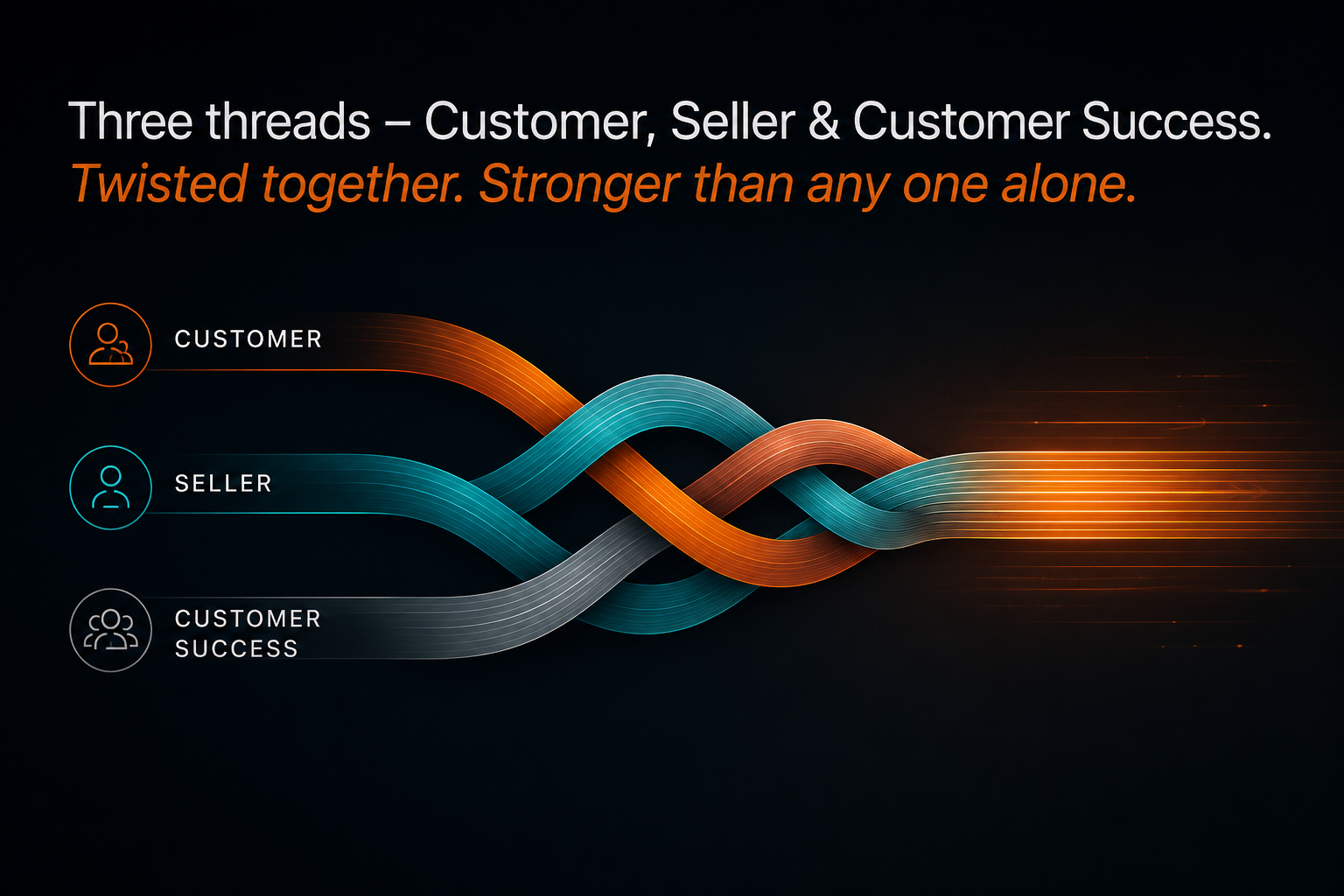
One: three threads, not one. Most methodologies are seller-centric. CORD runs three threads through every stage. The customer thread ensures the buyer is an active participant, not a passive target. The seller thread provides the strategic and commercial discipline needed to progress the deal. The customer success thread ensures delivery and renewal are in the conversation from day one, by design, not as an afterthought.
Two: linear becomes cyclical. CORD begins as a linear process. It matures into a cycle. The relationship does not end at signature. The artefacts built during the sale carry directly into delivery, renewal and expansion. Most methodologies hand off to customer success at the moment of signature and lose the institutional memory in the process.
Three: outcomes are the organising principle, not a sales tactic. A lot of methodologies talk about outcomes. CORD treats them as the contract that holds the relationship together: visible, agreed, and revisited at every stage.
This is the question I get asked most often, and it matters more than ever.
The market is filling up with AI agents that promise to guide sellers, inside CRMs, inside Slack, inside content platforms, inside dialler tools. Each one is convinced it has the answer. None of them are trained on your methodology, your competency model, or the specifics of your deals.
The result, if you are not careful, is sellers receiving conflicting guidance from multiple AI agents. None of which agree, and none of which are accountable to a shared standard.
CORD sits one layer above this. The methodology is the guardian. The AI tools feed it with signal: call transcripts, CRM data, content engagement, conversation intelligence. CORD provides the structure that translates that signal into guidance adhering to a single, approved approach.
The principle is simple.
Generic AI gives generic guidance. A methodology that knows your deals, your sellers and your competency model gives guidance worth acting on.
CORD is built for businesses selling complex, considered, multi-stakeholder deals. If your sales cycle involves a buying group of five or more, a six or seven-figure contract value, and a delivery commitment that lasts months or years, CORD is designed for you.
It is especially relevant for:
If your sales motion is transactional, with short cycles, single decision-makers and low contract values, CORD is probably not the right fit. There are good methodologies for that environment. This isn’t one of them.
I don’t think AI is going to replace good salespeople. I think it will make average salespeople look even more average and great salespeople look exceptional. The differentiator will be the methodology underneath: whether the seller has a shared language, a shared set of tools, and a shared definition of what good looks like.
That is what we have tried to build with CORD. It is built for the world we are actually selling in.
If you’d like to talk through how CORD could work in your commercial environment, get in touch with the Sales Engine team. We’d be happy to walk through it with you.
Steve Robinson is CEO of Sales Engine.
New to Sales Engine? Begin with the Commercial Performance Diagnostic.